
Page introduction
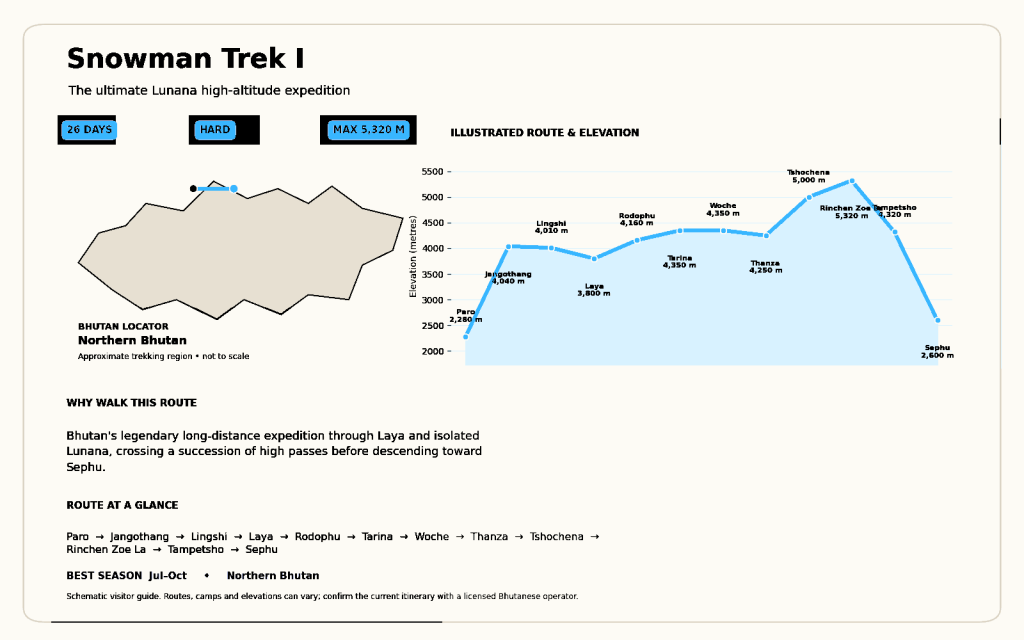
Snowman Trek I is Bhutan’s legendary long-distance expedition through the remote northern Himalaya. From Paro, it travels beneath Jomolhari through Lingshi and Laya, enters isolated Lunana and crosses a succession of high passes before turning south towards Sephu. Success depends as much on weather, acclimatisation and logistics as on physical fitness.
Quick facts
| Detail | Information |
|---|---|
| Duration | 26 days |
| Difficulty | Hard |
| Maximum elevation | 5,320 m |
| Best season | July–October |
| Route | Paro → Jangothang → Lingshi → Laya → Rodophu → Tarina → Woche → Thanza → Tshochena → Rinchen Zoe La → Tampetsho → Sephu |
| Best suited to | Highly experienced expedition trekkers |
Highlights
- Complete one of the Himalaya’s most demanding established trekking journeys.
- Travel through Laya and the isolated settlements and valleys of Lunana.
- Cross multiple passes around or above 5,000 metres.
- Witness immense glacial landscapes, alpine lakes and rarely visited mountain country.
Indicative 26-day route outline
- Days 1–4 — Paro to Jangothang: Follow the upper Paro valley and acclimatise beneath Jomolhari.
- Days 5–8 — Jangothang to Lingshi and Chebisa country: Cross early high passes while building a conservative altitude profile.
- Days 9–11 — Shomuthang and Robluthang to Laya: Traverse remote pasture and reach the Laya community.
- Days 12–15 — Laya to Rodophu and Tarina: Enter increasingly isolated terrain through major pass systems.
- Days 16–18 — Woche to Lhedi and Thanza: Reach the Lunana settlements; retain recovery and contingency time.
- Days 19–22 — Thanza to Tshochena: Leave Lunana over successive high camps and passes.
- Days 23–24 — Rinchen Zoe La to Tampetsho: Cross the trek’s critical high ground.
- Days 25–26 — Descent to Sephu: Complete the long descent to the road connection.
The operator must map every camp and acclimatisation day before sale; the outline above is editorial content, not a field navigation plan.
Expedition readiness
Applicants should have completed several multi-week, high-altitude treks and be comfortable with cold camping, long days and itinerary disruption. Snow, rain, damaged bridges, pack-animal problems or illness can prevent completion. Emergency evacuation may be delayed or impossible in poor weather. Comprehensive insurance, medical screening and contingency days are essential.
Frequently asked questions
Why do some groups not complete the Snowman Trek? A narrow weather window, multiple high passes, extended remoteness and logistical complexity create many opportunities for delay or retreat.
Can a very fit beginner join? Fitness alone is insufficient. Prior high-altitude expedition experience and a proven response to long camping journeys are strongly recommended.