
Page introduction
The Far-Out East Bhutan Trek explores remote villages and pilgrimage landscapes in Trashi Yangtse. From Tsenkharla, it travels through Nangkhar and cliff-side Omba Ney, crosses the Shangphula area, continues to Jangphu and Gongza Ney, and descends towards Doksum. It is a strong choice for travellers who value cultural discovery, quiet trails and eastern Bhutan’s intimate landscapes.
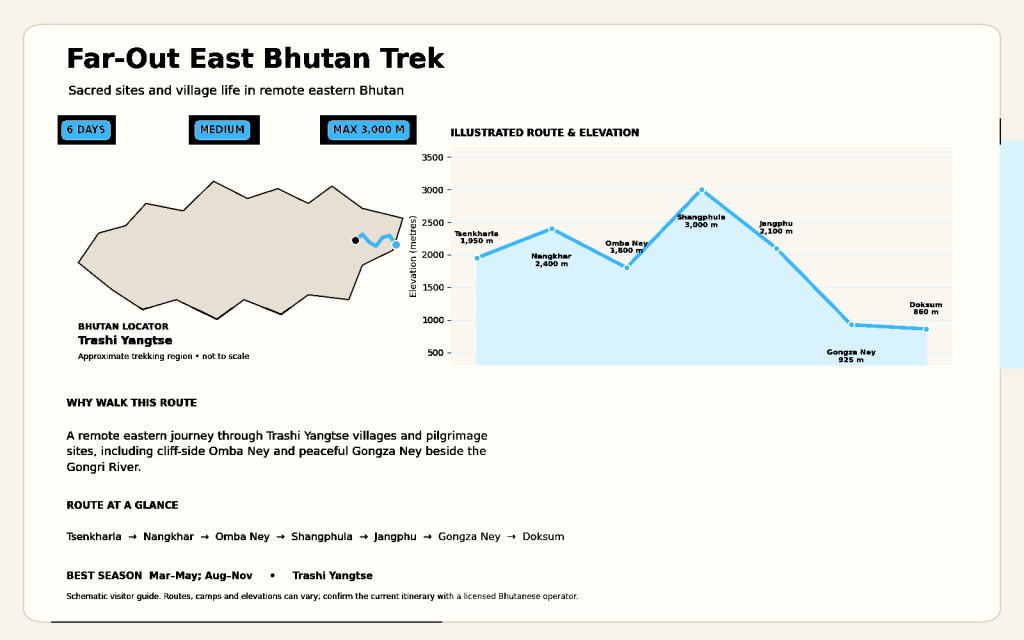
Quick facts
| Detail | Information |
|---|---|
| Duration | 6 days |
| Difficulty | Medium |
| Maximum elevation | 3,000 m |
| Best season | March–May; August–November |
| Route | Tsenkharla → Nangkhar → Omba Ney → Shangphula → Jangphu → Gongza Ney → Doksum |
| Best suited to | Repeat visitors, culture lovers and walkers seeking an uncommon route |
Highlights
- Visit Omba Ney, a sacred cliff-side pilgrimage site.
- Travel between eastern villages rarely included in standard Bhutan itineraries.
- Experience forest ridges, river valleys and spiritual sites in one route.
- End near Doksum, a useful connection point for eastern touring.
Indicative itinerary
- Tsenkharla to Nangkhar: Begin through village and forest landscapes.
- Nangkhar to Omba Ney: Reach the sacred cliff area, approaching respectfully and under guide direction.
- Omba Ney to Shangphula: Cross higher forest and ridge terrain.
- Shangphula to Jangphu: Continue through remote countryside.
- Jangphu to Gongza Ney: Descend towards a peaceful pilgrimage landscape near the Gongri River.
- Gongza Ney to Doksum: Complete the route and transfer onward.
What to expect
Trail conditions on lesser-used eastern routes can change. Expect steep sections, simple camps or local accommodation and longer vehicle transfers before and after the walk. At pilgrimage sites, follow the guide’s instructions regarding photography, offerings and access.
Frequently asked questions
Where is this trek? It lies in the far east around Trashi Yangtse, well beyond the commonly visited Paro–Thimphu–Punakha circuit.
Is it high altitude? The listed maximum is about 3,000 metres, so altitude is less extreme than on the Jomolhari or Snowman routes, though hills and remote terrain still justify preparation.