
Page introduction
The Nabji–Korphu Trek is a warm, low-altitude community journey through south-central Bhutan’s Black Mountains region. From Tongtongphey, it links Jangbi, Kubra, Nabji, Korphu and Nyimshong before ending near Reotola. Broadleaf forest, agricultural villages and sacred sites associated with Guru Rinpoche give the route a character quite different from Bhutan’s alpine treks.
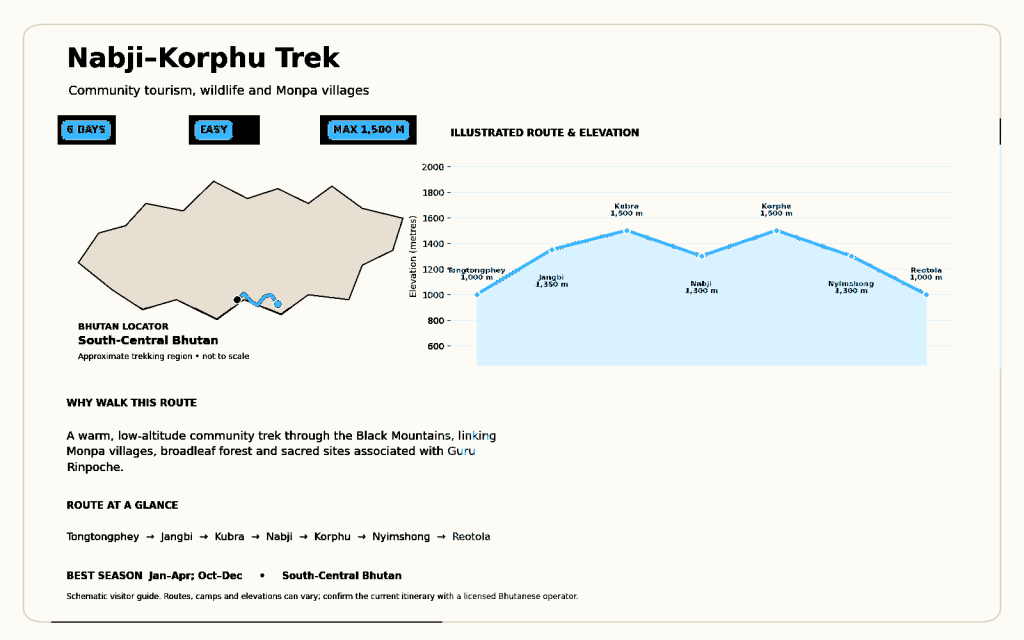
Quick facts
| Detail | Information |
|---|---|
| Duration | 6 days |
| Difficulty | Easy |
| Maximum elevation | 1,500 m |
| Best season | January–April; October–December |
| Route | Tongtongphey → Jangbi → Kubra → Nabji → Korphu → Nyimshong → Reotola |
| Best suited to | Beginners, community-tourism supporters, birders and winter visitors |
Highlights
- Walk through biologically rich subtropical and broadleaf forest.
- Visit Monpa and other rural communities along a lower-elevation route.
- Discover local legends, temples and sacred landscapes.
- Trek during months when many Himalayan passes are too cold or snowy.
Indicative itinerary
- Tongtongphey to Jangbi: Leave the road and walk into village and forest country.
- Jangbi to Kubra: Continue through a rich natural and cultural landscape.
- Kubra to Nabji: Reach Nabji and learn the site’s stories with a local guide.
- Nabji to Korphu: Follow community trails to Korphu.
- Korphu to Nyimshong: Continue through forest and agricultural land.
- Nyimshong to Reotola: Finish at the roadhead and transfer onward.
What to expect
Lower altitude reduces the risk of altitude illness, but heat, humidity, insects, rain and slippery paths bring different challenges. Lightweight long sleeves, insect protection, fast-drying clothing and a reliable rain shell are useful. Community-based accommodation or camps may be simple and should be presented honestly.
Frequently asked questions
Is this a good winter trek? Yes. The lower elevation makes it more viable in cooler months than Bhutan’s alpine routes, although current rain and trail conditions still need checking.
Is wildlife guaranteed? No. The region has rich biodiversity, but sightings depend on season, luck and quiet behaviour.